Quarterly Market Update - May 2026
Over the past few months, we’ve had a number of conversations that sound something like this:
“I think I’m just going to wait for things to settle down before investing.”
It’s a completely reasonable instinct. Markets feel uncertain, headlines are noisy, and there’s no shortage of things competing for attention, from interest rates and inflation to geopolitical tensions. For someone sitting on the sidelines or considering pulling back, waiting for more clarity before investing can feel disciplined.
The hardest part of investing today isn’t volatility. It’s exhaustion. Every day brings a new reason to reconsider, second‑guess, or “just wait a little longer.” That constant decision pressure wears us down, and over time it can lead to choices driven less by strategy and more by the desire for relief.
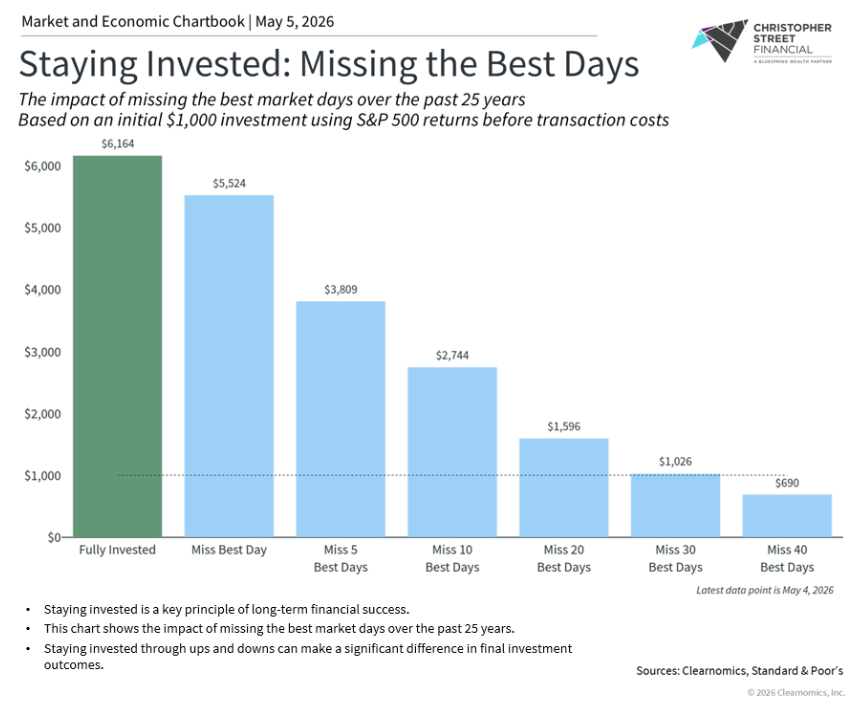
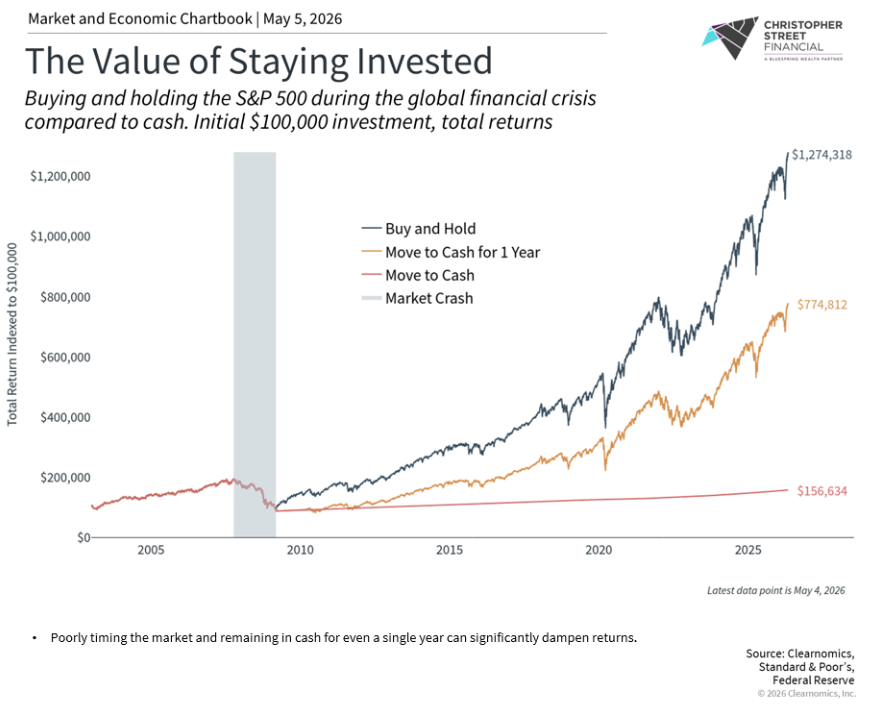
The challenge is that markets don’t reward staying uninvested, or reducing exposure to equity markets, in the way many expect. Periods of uncertainty rarely end with a clear signal that it’s time to invest again. In fact, markets often begin to recover well before the news improves. By the time things feel more “certain,” a meaningful portion of returns has often already occurred.
This creates a difficult dynamic: the more comfortable it feels to invest, the less opportunity there often is. We see this play out in different ways. Sometimes it’s holding excess cash while waiting for a better entry point, other times it’s pulling back after volatility with the intention of re-entering later. In both cases, the decision feels cautious, but it can quietly come at a cost.
None of this is to suggest that uncertainty isn’t real, or that markets won’t experience volatility along the way. They will. But uncertainty is a constant, not an exception. Waiting for it to disappear isn’t a strategy - it’s a moving target.
A more reasonable approach is to focus on what we can control: maintaining a thoughtful allocation, staying aligned with long-term goals, and making adjustments intentionally rather than reactively. Over the past two years, markets have shown us how this plays out. In 2025 alone, the S&P 500 fell nearly 19% at its worst point during the year amid tariff concerns and geopolitical tension, only to recover and finish the year up roughly mid‑teens. And in 2026 so far, markets endured another meaningful pullback, roughly 8–9%, before stabilizing and moving back into positive territory. Investors who react to volatility by moving to the sidelines generally don't avoid risk, they often miss some or all of the recovery.
That same focus on control and intentional decision‑making is what led Christopher Street to recently launch a new fixed income strategy. Over time, we’ve heard from many clients looking to further diversify their portfolios and generate more consistent income - particularly in an environment where uncertainty feels persistent and decision fatigue is real. Rather than reacting to short‑term market noise, the strategy was designed to address those needs thoughtfully: complementing existing allocations, emphasizing income, and playing a stabilizing role within a broader long‑term plan. It’s not about predicting what happens next - it’s about expanding the tools available to build resilient portfolios aligned with our clients’ goals.
As always, if you’re considering changes or simply want to talk through how this environment fits into your plan, we’re here to help you think it through.